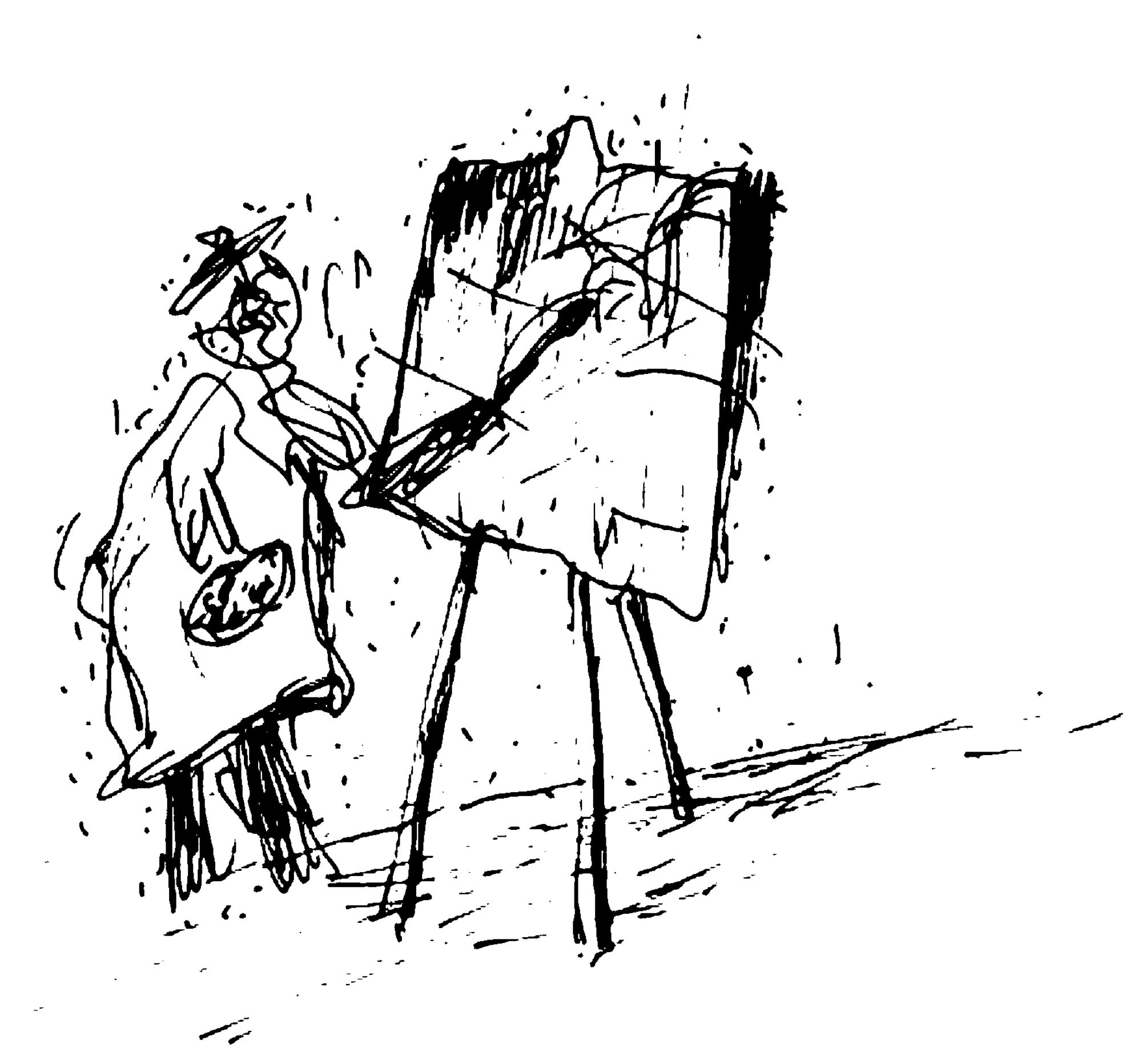
Çizen Çocuğa Notlar
Notes to a Child Who Draws
Memed Erdener, Eylül 2020
Robert Koch’un dediği gibi “neyi biliyorsa onu görür insan”. Çizmek, insanın kendisini ve çevresini tanımasını sağlar. Çizen biri, çizmeyen birine göre dünyayı daha fazla bilir ve deneyimler. Çiçekleri, ağaçları, arabaları, binaları gözlemleyerek çizen, annesine veya arkadaşlarına bakarak onların jestlerini resimlerine katan çocuk, beden dilini dolayısıyla canlı ve cansız varlıklarla empati yapma yeteneğini keşfeder.
“Hayvanlar konuşamadıkları için
Kimbilir ne güzel düşünürler,
Ellerimiz gibi.”
Çizen çocuk, Melih Cevdet Anday’ın yukarıdaki dizelerini bilmese de, şiirde anlatılmak isteneni hayatta sezer. Akıl ve el arasındaki hiyerarşik ilişkiyi ara sıra ters yüz ederek, eli kaptan köşküne çıkarır. Bazen düşünmeden çizerek eliyle düşünmeyi öğrenir. Böylece vücudun, zekanın devamı olduğunu anlar. Aklı ve eli arasında yaratıcı bir diyalektik ilişki başlar.
Kalemler, kağıtlar ve kitaplar hayatının ayrılmaz birer parçası oldukları için o takip edenlerden değildir. Alışkanlıklarını bırakabilir. Yeniye ve bilinmeyeni denemeye açıktır. Değişmek ve değiştirmek mutluluk verir ona. O kaşiftir. Kendine has, ayrıksı, kimine göre tuhaf beğenileri vardır onun. Çünkü beğeniler alışkanlıklar sonucu oluşur. Alışkanlıklarınızı değiştirirseniz beğenileriniz de değişecektir. O bunu bilir.
Çizen çocuk, çizmeyenin girmeyeceği arka sokaklara girer. Karanlıkla kendi başına mücadele eder. Tekrar aydınlığa çıkabilmek için kestirme yollar bulur. Güçlüklerle uğraşmayı, bir masa başında bir konuya odaklanarak saatler geçirmeyi erken yaşta deneyimler. Yalnızlık onun için korkulacak bir şey değil, aksine hayatın karmaşası içinde gözükmeyen, gizli kalmış anlama yaklaşıldığı anlardır. Çizen çocuk, çocuk yaşta mistisizmi farkeder, onu tanır. Sanat, asla bir taraftar kulübü olmayan kendine has bir tür ibadettir aslında.
Çizmeyi seven bir insan ömür boyu kendine yetebilir. İlkokulda sınıfta ilgi odağı olur, dikkat çeker ve bu ilginin karşılığını vermeyi dener. Önemli ve erken bir deneyimdir bu. İleride, üniversite yıllarında eğer güzel sanatlar, tasarım, mimarlık veya benzeri bir alanda okursa, kendi gibi yetenekli insanlarla yan yana bulunma şansı elde eder. Renge, forma, tabiata, edebiyata ve modaya, her türlü güzelliğe, çirkinliğe ve çelişkilere, müziğe, dansa, bedene ve mimariye ilgi duyan bir çevrenin içinde kendine yer edinir. Bu ilerici çevre onu ömür boyu besler ve aklını zinde tutar. Bu sayede o en iyi yayınları okur, en yeni oyunları izler. Sağlıklı kaynaklar sayesinde karşılıklı çıkarcılığı savunmaz. Böylece o, farketmeden, seçimleriyle cesur bir insan olur.
Sanatla veya tasarımla uğraşan kişinin, otuzlu yaşlarının başına geldiğinde elde ettiği en önemli kazanım özgür iradesidir. Özgür iradesini ne babasına, ne işyerindeki patrona, ne polise veya devlete, ne tarikat şeyhine ne de tanrıya teslim eder. Bilir ki vicdan denen kelime tanrının eşanlamlısıdır ve vicdan insandadır. Böylece özgür iradesi vasıtasıyla dünya ile, vicdanı vasıtasıyla bilinçdışı ile sağlıklı bir ilişki kurar. Şöyle de söyleyebiliriz: Hem diyalektiğe hem metafiziğe erişimi vardır onun.
Hayatı eşya biriktirme yarışı içinde geçen şehir insanının bulmakta zorlandığı maneviyatı, çizen biri tabiatta, şehrin kalabalığında, boş bir odada veya bir hayvanın uyuyuşunda bulur. Denizin dibindeki bir inci tanesi gibi zor bulunan ve derin hisler barındıran bu manevi şeyi imge diye niteler. İmge, sıradan insanın hatta kurumsal insanın fakir sözlüğünde yoktur. İmgeler hatıralardan daha güçlü hissedişlerdir. Bu sayede o, hafızaya ve dolayısıyla geçmişe önem veren bir insana evrilir. Kendine kattığı yoğun imgeler sayesinde ruhunu zenginleştirir. Jung’un dediği gibi “Bir şeyin imgesine sahipsek o şeyin yarısına sahibizdir. Dünyanın imgesi dünyanın yarısıdır.”
Hafızası, kültürü ve bir başkasına devredecek mirası olan çizen çocuk. İyi ki varsın.
As Robert Koch once said, “We see what we know”. Drawing helps us to get to know ourselves and our environment. A person who draws knows the world better and experiences the world more than one who does not. A child who observes and draws flowers, trees, cars and buildings, looks at her or his mother or friends and adds their gestures to her or his drawings, discovers what body language is and thus acquires the ability to empathize with living and non-living beings.
“Since they cannot talk
How beautifully animals must think,
Just like our hands.”
The child who draws may not be familiar with Melih Cevdet Anday’s lines quoted above, but will sense, in life, what the poem is trying to convey. From time to time, the child is thus able to reverse the hierarchical relationship between the mind and the hand, placing the hand in charge of the ship’s bridge. Now, sometimes, the child will draw without thinking, or perhaps, thinking with the hand. Thus the child comprehends that the body is an extension of the mind. A creative dialectical relationship between the mind and the hand commences.
Pencils, paper and books are an indispensable part of the life of the child who draws. Thus, the child who draws does not follow, can shed habits and remains open to experimenting with what is new and unknown. To change and to be changed are a source of joy. The child who draws is an explorer with unique, uncommon taste, or strange according to some, since taste is formed by habit. Change your habits, and your tastes will follow. The child who draws knows this well.
The child who draws enters into the backstreets that the child who does not draw dares not. The child who draws dares to struggle with the darkness alone, finding shortcuts that will lead back to the light. The child who draws experiences, at an early age, how to deal with challenges and feels the joy of spending hours at a desk, focusing on a single subject. Solitude is not something to be feared, in contrast, solitary moments are those when one approaches the secret meaning rendered invisible by life’s chaos. The child who draws becomes aware of, and recognizes mystical at an early age. Art is, in fact, a unique form of prayer that is certainly not a club with supporters.
A person who loves drawing is able to remain self-sufficient for a life time. Such a person is the centre of attention in class in primary school, drawing attention and seeking to respond to this attention. This is an important, early experience. If this person chooses to study fine arts, design, architecture or a similar branch at university, he or she will have the opportunity to meet other talented individuals, gaining a place in an environment that shows interest to colour, form, nature, literature and fashion, all manners of beauty, ugliness and contradictions, music, dance, the body and architecture. This progressive environment will be a source of sustenance for a life time, keeping the mind fit and healthy. This is the path to read the best publications, the best new plays. Access to healthy sources also means that such an individual is not inclined towards a worldview based on self-interest. Thus, unwittingly, his or her choices shall turn this individual into a courageous person.
The most important acquisition of a person occupied with art or design, by his or her early thirties, is free will. This person does not surrender that free will to his or her father, the boss at the workplace, the police or the state, the sect leader or god. This person knows that conscience, this word, is synonmous with god, and it is human beings who possess conscience. Thus, through this free will, he or she forms a healthy relationship with the world, and a healthy relationship with the unsconscious through conscience. We could also put it this way: This person has access both to dialectics and metaphysics.
Urban dwellers spend their life in a race to collect more and more belongings, and spirituality is hard to come by: Yet a person who draws discovers spirituality in nature, in the crowds, in an empty room or in the sleep of an animal. The person who draws gives a name to this spiritual thing that is as rare as a pearl at the bottom of the ocean and contains the deepest of feelings: the image. The image is absent in the impoverished dictionary of the everyday individual, and even the corporate individual. Images are sensations more powerful than memories. Through images, the person who draws evolves towards memory and thus, becomes a person who values the past. By absorbing intense images, the soul is enriched. As Jung said, “If we possess the image of a thing, we possess half the thing. The image of the world is half the world.”
O, the child who draws the memory, culture and heritage to be passed on to another, I celebrate your existence.